Germanium Whitepaper
Germanium – The Most Futuristic Element
Must Read! Why Invest in Germanium?
Artificial intelligence, advanced semiconductors, defense technologies, and global communications all rely on one little-known critical mineral: germanium.
Although it receives far less attention than lithium, copper or rare earth elements, germanium has become one of the world’s most strategically important technology metals. Its unique physical and optical properties make it indispensable in fiber optic networks, infrared imaging systems, semiconductor devices and space technologies.
At the same time, global supply remains limited because germanium is rarely mined as a primary commodity. Most production comes as a by-product of zinc refining, while processing capacity is heavily concentrated in China. As governments seek to strengthen critical mineral supply chains and reduce dependence on a single supplier, germanium has emerged as a strategic investment opportunity.
What is Germanium?
Germanium is a silvery-grey metalloid with exceptional electrical and optical properties. Discovered in 1886 by German chemist Clemens Winkler, it quickly became an important material for early semiconductor research and the first generation of transistors.
Today, germanium is valued for its ability to conduct electricity under controlled conditions while remaining highly transparent to infrared light. These characteristics make it difficult to replace in many advanced technologies.
Unlike bulk industrial metals, germanium is primarily produced as a by-product during zinc processing, making global supply naturally constrained and less responsive to increases in demand.
Common Types of Germanium
Germanium is produced in several forms depending on its end use:
Germanium Dioxide (GeO₂) — A white powder and one of the most important commercial forms of germanium. It is widely used as an intermediate for producing germanium metal and in applications such as fiber optics, infrared optics, and specialty glass.
Germanium Metal — Refined elemental germanium commonly supplied as ingots, bars, blocks, or pieces. It is available in various purity grades and is used in semiconductor, optical, photovoltaic, and other high-performance applications.
Germanium Granules / Pellets — Small pieces of elemental germanium supplied for applications requiring controlled quantities or easier handling than larger ingots. They are used in materials processing, deposition, and other industrial applications.
Germanium Powder — Finely divided elemental germanium available in different particle sizes and purity levels. It is used in materials processing, coating and deposition, research, and specialized manufacturing.
Why Germanium Matters
Germanium is much more than another critical mineral. It is a foundational material that enables many of today’s fastest-growing industries.
Its unique properties support technologies that power modern economies, including:
- Fiber optic communications
- Artificial intelligence infrastructure
- Advanced semiconductors
- Infrared optics
- Aerospace and satellites
- Defense and national security systems
As digital infrastructure expands and geopolitical competition increases, secure access to germanium is becoming increasingly important.

Scintillating Glass Optical Fibers
Fiber Optics and Digital Infrastructure
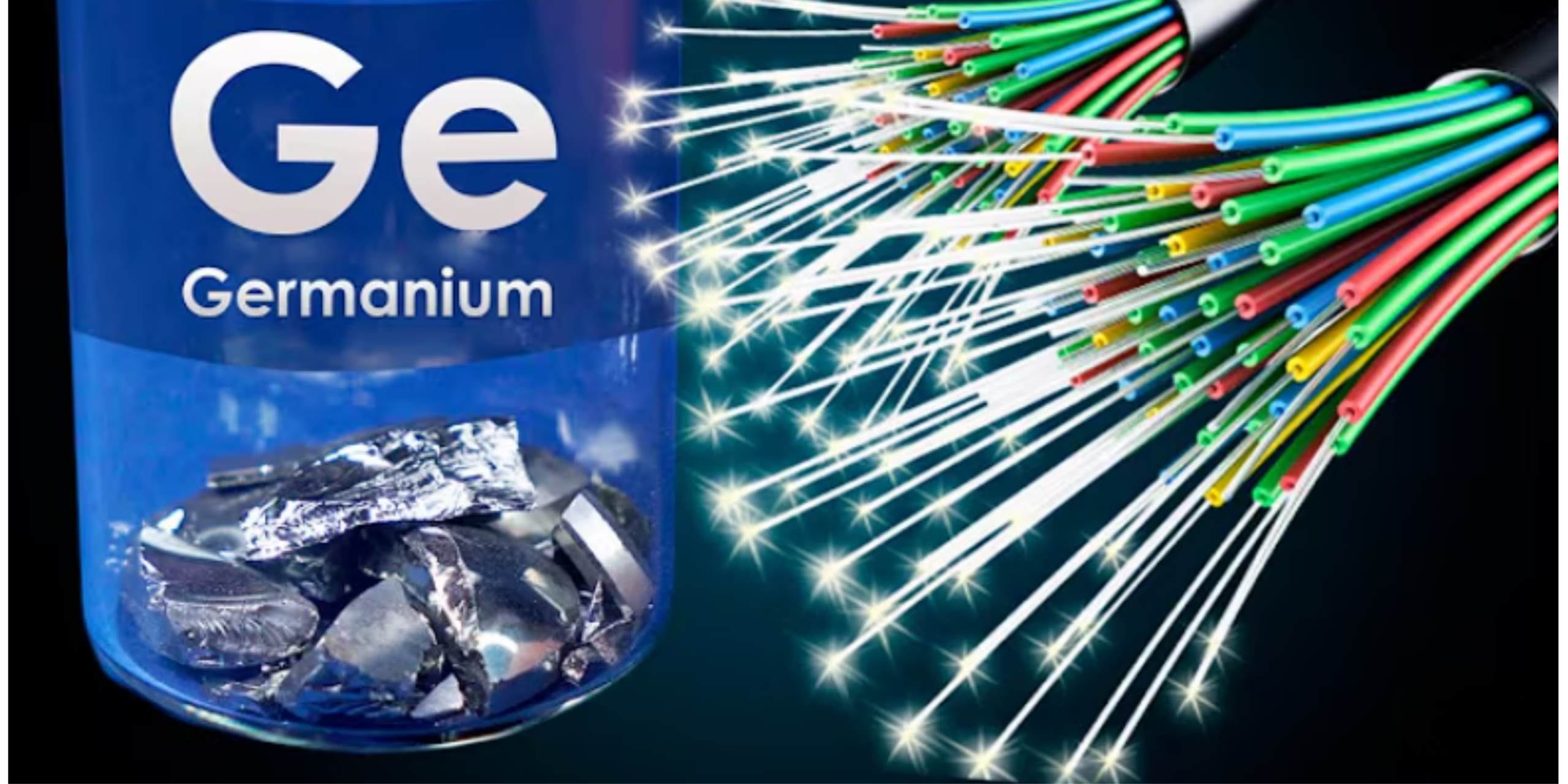
Fiber optic communications represent the largest commercial use of germanium, accounting for 30-40% of germanium demand.
Germanium is a critical material in fiber-optic technology, where germanium dioxide (GeO₂) is incorporated into high-purity silica to precisely increase the refractive index of the fiber core. This controlled change in refractive index creates the core–cladding contrast required for total internal reflection, keeping light signals confined within the core for efficient, low-loss transmission over long distances. By controlling the concentration and distribution of germanium, fiber manufacturers can engineer the optical fiber’s refractive-index profile, dispersion, and light-guiding performance. This makes germanium essential to the production of high-performance optical fibers used in telecommunications, broadband networks, data centers, and high-speed internet infrastructure.
Germanium and the Fiber-Optics Demand Surge
The rapid buildout of AI and hyperscale data centers is driving a sharp increase in fiber-optic demand. Commodities Research Unit estimates data-center optical cable demand could rise from approximately 39.1 million fiber-kilometers in 2024 to 97.1 million in 2026, highlighting the scale of AI-driven network expansion. As more optical fiber is manufactured for AI infrastructure, data-center interconnects, and high-speed communications, demand for germanium used in fiber production is expected to increase substantially and remain a major driver of germanium consumption.

Thermal Imaging Lenses

Lidar Illustrative Image
Infrared Optics, Defense and Space Technologies
One of germanium’s most valuable characteristics is its exceptional transparency to infrared light.
This makes it a preferred material for manufacturing thermal imaging lenses used in:
- Night vision systems
- Thermal cameras
- Missile guidance systems
- Border surveillance
- Military sensors
Infrared optics is emerging as a strong growth application for germanium: elemental germanium combines high infrared transmission with a very high refractive index—about 4 at 10.6 μm—making it effective for compact, high-performance lenses and windows in the mid- and long-wave infrared. It is particularly suited to the 8–14 μm thermal-imaging band, where germanium optics transmit infrared radiation to detectors while its high refractive index enables strong optical power with relatively compact lens geometries; anti-reflective coatings are typically applied to reduce surface reflection losses. The global germanium IR-lens market is projected to grow from US$376.65 million in 2025 to US$654.54 million by 2032, a 73.8% increase at an 8.21% CAGR, driven by demand for thermal imaging, night vision, defense, automotive sensing, and industrial infrared systems.
Beyond infrared lenses, germanium plays an important role in several other defense and space technologies because of its semiconductor, optoelectronic and materials properties. High-purity germanium is used in infrared detector technologies, while germanium-based materials and silicon-germanium (SiGe) semiconductors can support high-frequency electronics relevant to radar, communications and sensing systems; the high carrier mobility of germanium helps enable fast electronic devices.
Germanium is also particularly important in space power systems: its crystal wafers serve as substrates for high-efficiency III-V multijunction solar cells, where the close lattice match between germanium and gallium arsenide enables the growth of high-performance photovoltaic structures capable of providing high power-to-weight performance in satellites. Germanium-based detector technologies have additionally been used in space science missions, including infrared and gamma-ray instruments. NASA, for example, has investigated germanium focal-plane arrays for far-infrared astronomy, while germanium-based instruments have contributed to planetary observations. These applications reinforce germanium’s strategic importance to defense and aerospace supply chains.
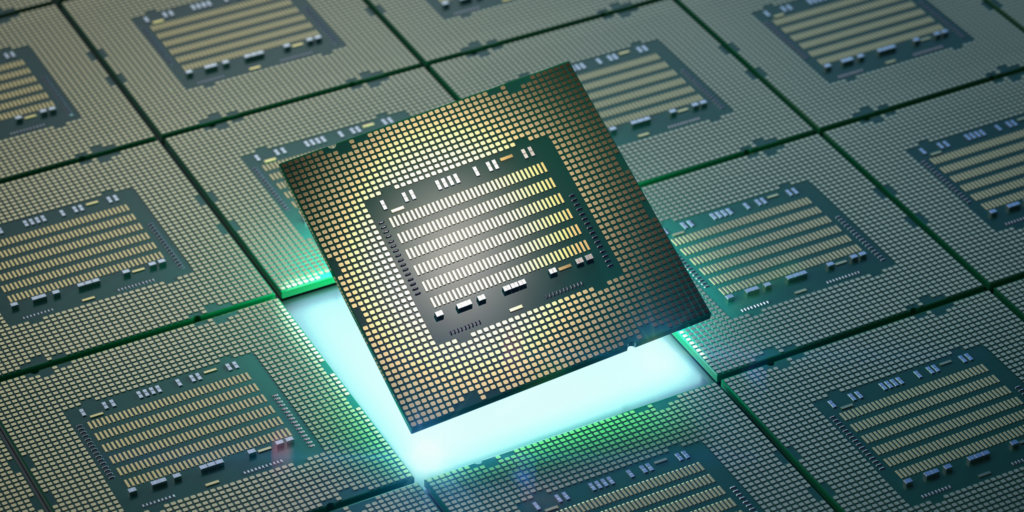
Chipset for Semiconductor Manufacturing
Semiconductors, AI and High-Speed Computing
Germanium is gaining importance in advanced semiconductor and high-speed chip applications because its high electron mobility supports faster charge transport, while its use in silicon-germanium (SiGe) heterostructures improves transistor speed and high-frequency performance. Germanium is also used as a precursor for germane (GeH₄), which enables controlled deposition of germanium and SiGe layers in semiconductor fabrication, including advanced transistors and high-frequency RF devices.
The growth outlook is significant: the global SiGe materials and devices market is forecast to expand from US$10.3 billion in 2024 to US$18.3 billion by 2030, a 78% increase at a 10.1% CAGR, driven by high-performance computing, telecommunications and automotive electronics. More directly tied to germanium consumption, the electronic-grade germane market is projected to grow from US$169.8 million in 2024 to US$347 million by 2030, a 104% increase at a 12.7% CAGR, with semiconductors accounting for more than 70% of demand.
Today, germanium is increasingly used in high-speed chips, silicon-germanium technologies, photonics and next-generation communications systems that support artificial intelligence, cloud computing and high-performance data centers. This makes semiconductors, SiGe devices, and electronic-grade germane an increasingly important growth channel for germanium alongside fiber optics and infrared optics. As governments invest billions of dollars to strengthen domestic semiconductor manufacturing, demand for strategic semiconductor materials such as germanium is expected to increase.
Scarcity and Supply Constraints
Unlike many critical minerals, germanium production cannot easily expand to meet rising demand.
Several factors contribute to this structural supply constraint:
- By-Product Production
Most germanium is recovered during zinc refining rather than mined directly. As a result, production depends largely on zinc output rather than germanium demand. - Limited Global Production
Only a relatively small number of facilities worldwide are capable of producing high-purity germanium suitable for advanced industrial applications. - Geographic Concentration
China dominates global germanium refining and processing capacity, making supply vulnerable to geopolitical tensions and trade restrictions. - Slow Supply Growth
Because new primary germanium mines are rare and refining capacity is limited, bringing additional supply to market can take years.
These characteristics make germanium one of the more supply-constrained critical minerals supporting advanced technologies.

Tennessee’s New Smelter to Model Korea Zinc’s Onsan Smelter
Germanium Market Outlook
Germanium prices are shaped by a small and specialized global market, where supply is limited and demand is concentrated in high-value industrial applications such as fiber optics, semiconductors and infrared optics.
In recent years, prices have been influenced by tightening supply conditions and periodic disruptions in global trade flows, including export restrictions introduced by China in 2023. These developments highlighted the sensitivity of the market to policy and supply chain shifts.
Because germanium is primarily produced as a by-product of zinc refining, supply does not respond quickly to changes in demand or price. This can result in periods of tightness when industrial consumption increases or when geopolitical factors restrict availability.
As a result, germanium tends to trade in a structurally constrained market environment, where relatively small changes in supply or demand can have an outsized impact on pricing.
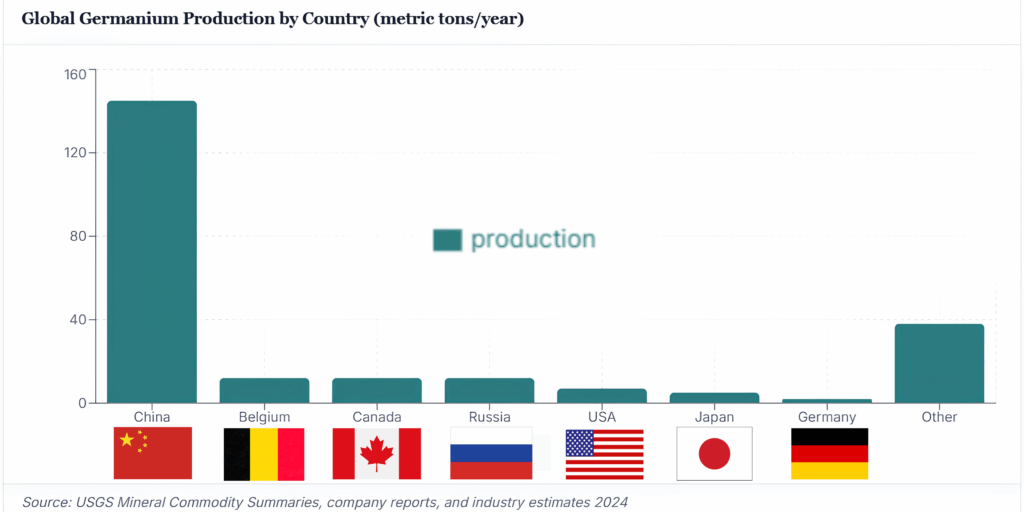
Global Germanium Production by Country in 2024
Germanium Price Chart
For historical price trends and updated market data, the following sources provide regularly maintained charts:
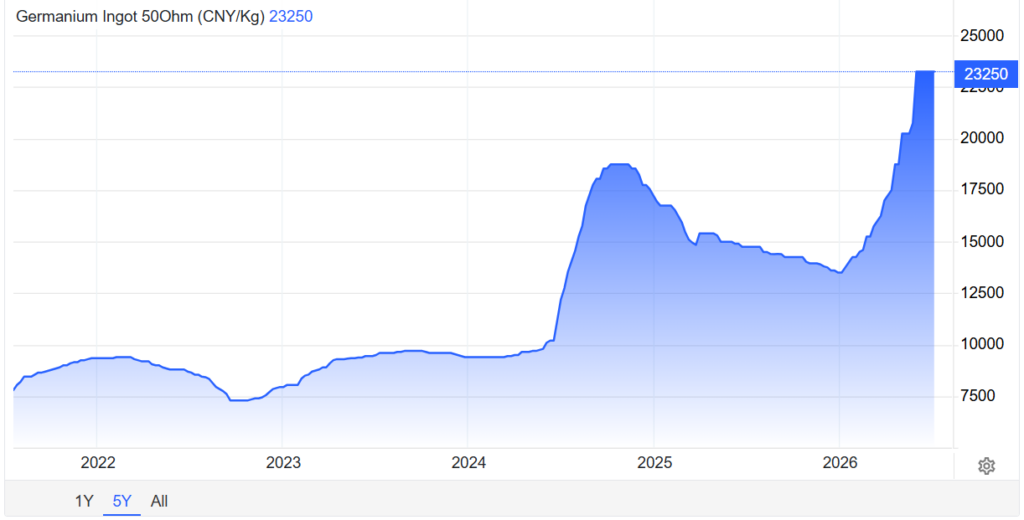
Germanium Ingot 50Ohm (CNY/KG) Price Chart, July, 2026
Germanium as a Critical Mineral
Germanium has been designated as a critical mineral by numerous governments, including the United States, Canada, the European Union and Australia.
Its importance extends well beyond commercial applications. Secure germanium supply is increasingly viewed as essential for:
- National security
- Semiconductor manufacturing
- Telecommunications infrastructure
- Aerospace
- Defense technologies
- Economic resilience
China’s export controls introduced in recent years have further highlighted the risks associated with concentrated supply chains and accelerated efforts to develop alternative sources of production.
Why Invest in Germanium?
Few critical minerals combine growing demand, structural supply constraints and geopolitical importance as clearly as germanium.
Several long-term trends continue to strengthen the investment case:
- Expansion of AI infrastructure and hyperscale data centers
- Continued deployment of fiber optic communications networks
- Growth in semiconductor manufacturing
- Rising global defense spending
- Increased investment in space technologies and satellite communications
- Limited global production and slow supply growth
- Heavy reliance on Chinese refining capacity
Unlike many commodities, germanium supply cannot rapidly respond to higher prices because most production depends on zinc mining rather than dedicated germanium operations. This structural imbalance between supply and demand could become increasingly significant as advanced technologies continue to expand.
Major Companies that Explore Germanium
Silver Elephant Mining Corp (TSX:ELEF)
Germanium Mining Corp (CSE:GMC)
Blue Moon Metals (TSXV:MOON)
History of Germanium
Germanium (Ge) has a unique place in the history of modern technology. Discovered in 1886 by German chemist Clemens Winkler, the element had first been predicted by Dmitri Mendeleev 15 years earlier. Mendeleev called the undiscovered element “eka-silicon” and accurately predicted several of its properties based on its position in the periodic table. Winkler isolated germanium while analyzing the silver-rich mineral argyrodite near Freiberg, Germany, and named the new element after his homeland.
Germanium and the Birth of the Transistor
For decades after its discovery, germanium had limited commercial applications. Its importance changed dramatically in the 1940s, when researchers began exploiting its semiconductor properties. Germanium was used in early radar technology and became the material at the heart of the first working transistor.
In December 1947, physicists John Bardeen and Walter Brattain at Bell Telephone Laboratories demonstrated the first successful point-contact transistor using a small piece of high-purity germanium and two closely spaced gold contacts. Their breakthrough provided a practical alternative to bulky vacuum tubes and helped establish the foundation of modern solid-state electronics.
Bardeen, Brattain, and William Shockley were awarded the 1956 Nobel Prize in Physics for their research on semiconductors and the discovery of the transistor effect.
Germanium’s Role in Modern Technology
Germanium’s value today extends beyond its early role in semiconductor development. Germanium is quietly becoming one of the world’s most strategically important technology metals.
Its indispensable role in fiber optics, semiconductors, infrared imaging, defense systems and space technologies places it at the centre of several long-term global growth trends. Combined with limited supply, increasing geopolitical importance and growing government focus on supply chain security, germanium presents a compelling investment opportunity for those seeking exposure to the next generation of critical minerals.
As the digital economy, artificial intelligence and advanced manufacturing continue to evolve, germanium is expected to remain an essential building block of the technologies shaping the future.
Germanium as a Byproduct of Zinc Production in Illinois-Kentucky Fluorspar District
The Illinois-Kentucky Fluorspar District has a documented history of germanium recovery as a byproduct of zinc production. USGS records from the mid-20th century specifically identify the Illinois-Kentucky district as a source of zinc, lead, cadmium, gallium, and germanium, with germanium occurring in the district’s zinc ores and concentrates. Germanium occurs primarily within sphalerite, the principal zinc sulfide mineral, and historical Bureau of Mines analyses found germanium concentrations of up to 0.035% (350 ppm) in some zinc concentrates from the Illinois-Kentucky Fluorspar District. The district was recognized as one of the historical U.S. sources of trace minerals, including germanium-bearing zinc concentrates.
Germanium remains strategically important today because it is relatively scarce and is primarily recovered as a byproduct of zinc ore processing, rather than being mined from large, dedicated germanium deposits. This makes its availability closely connected to the production and processing of other minerals.
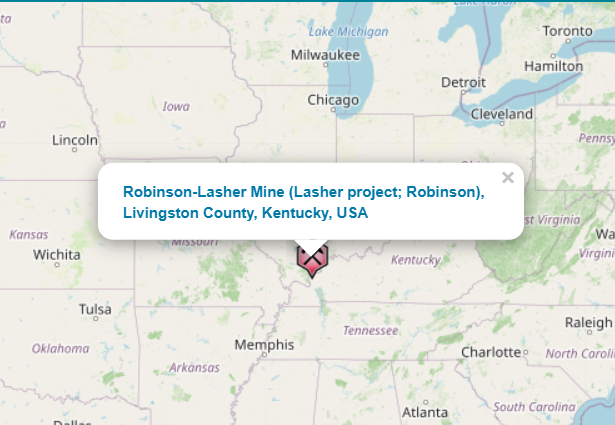
Robinson-Lasher Prime Address: New Zinc-Gallium-Germanium Smelter Hub Within 90 Miles
On December 15, 2025[1], Korea Zinc Co., Ltd., which owns and operates the world’s largest non-ferrous metals Onsan smelter in Ulsan, South Korea, announced a proposed US$7.4 billion integrated zinc and critical minerals smelter to be built in Clarksville, Tennessee, through its U.S. subsidiary Crucible Metals, LLC and joint venture vehicle Crucible JV LLC. The project is reported to be backed by the U.S. Government and private capital, including the U.S. Department of War (the largest voting holder of the joint venture) and the U.S. Department of Commerce, which awarded a US$210 million CHIPS Act grant, together with approximately US$1.94 billion of equity from the U.S. Government and strategic investors and approximately US$4.7 billion of debt financing arranged by the U.S. Department of War and J.P. Morgan (J.P. Morgan providing US$2.349 billion).[2]
The facility is expected to be the first primary zinc smelter built in the United States since the 1970s, constructed on the site of the former Nyrstar Clarksville smelter — the only operating primary zinc smelter in the U.S. — which Crucible Metals has acquired. Modeled on Korea Zinc’s flagship Onsan complex, the Clarksville facility is designed to produce, at full capacity, approximately 300,000 tonnes of zinc, 200,000 tonnes of lead and 35,000 tonnes of copper annually, plus strategic by-products including antimony, indium, bismuth, tellurium, germanium and gallium — 13 products in total, 11 designated as critical minerals by the U.S. Government.[3] Phased commercial operations are slated to begin in 2029.
CleanTech estimates this implies a zinc concentrate feed requirement on the order of 600,000 to 700,000 tonnes per year for the smelter. Korea Zinc has publicly stated it intends to prioritize sourcing feedstock domestically within the United States and from Mexico and South America. The Company believes the potential zinc-gallium-germanium concentrate production from the Robinson-Lasher Project can be a valuable, and highly sought-after feedstock to the new smelter facing declining domestic zinc concentrate feed from dwindling already existing zinc mining projects.
Check Out Silver Elephant Germanium Project
[1] https://www.nist.gov/news-events/news/2025/12/department-commerce-awards-chips-incentives-subsidiary-korea-zinc-crucible
[2] https://investors.koreazinc.co.kr/media/z1pp5yu3/korea-zinc-us-smelter-investment-english.pdf
[3] https://investors.koreazinc.co.kr/media/z1pp5yu3/korea-zinc-us-smelter-investment-english.pdf